Balthus, the artist, was a fascinating character. Nicholas Fox Weber, the writer, wrote an excellent biography on the amazing life of Balthus. The book “Balthus-A Biography” was published in 1999 when Balthus was still alive and Weber was able to interview him over a number of years.
I find that the paintings by Balthus are evocative, provocative, erotic and dreamlike. I felt an immediate connection with his work. Even though his paintings and my photographs are very different, they both elicit similar responses from viewers especially concerning the nudes.
Balthus and I react to probing questions about our work with similar responses. When questioned about the meaning or message of a particular painting, a Balthus response was: “It’s absolutely not symbolic. The meaning of the painting is the painting.”
When Weber asked him about the painting “The Room” Balthus replied that “The Room” is simply a painting of a nude in a room with a girl at the window.
Another Balthus response when questioned about eroticism in his paintings was: “The problem is that everyone sees eroticism. My pictures aren’t erotic. The problem is psychoanalysis.”
Quotes from my writings reflect similar reactions to criticisms of my photographs. In 1997, I wrote a “Personal Statement” as an introduction to a book featuring my early nude work where I wrote: “A common reaction to my work is that the images are disturbing. The images are not disturbing to me. They are simply expressions.”
Another quote which is from my “Artist Statement” is: “I make my work without a social or political agenda. There is no message or hidden purpose. The photograph is the photograph. What the viewer sees and interprets is out of my control.”
While reading the book on Balthus, I found the similarities between our responses and thinking processes to be uncanny. Also, the relentless questioning of Balthus’s artistic intent by Weber reminded me of my graduate school professor, John Weiss, and his agitation with my responses regarding my work. His normal reaction was that I should take more responsibility for my photographs instead of denying intent. Neither Weber or Weiss could accept either of our simplistic responses to our work. They both pushed for more information in an accusatory manner as if we were taking the easy way out instead of searching for meanings in our work. For me the information that was wanted was neither available nor important to me.
An observation made by Claus von Bülow, a friend of Balthus, was that he felt Balthus more as a perpetual voyeur of women that as an active lover. When I photograph a model, I view it as a business relationship and not a chance for a romantic relationship. But I would say that I am a voyeur of women. The difference between Balthus and myself is that he preferred young girls where my preference is to photograph older mature women.
Another difference is that I believe my unconscious plays a role in my image making whereas Balthus vehemently denied any influence from the unconscious.
For me, the work of Balthus stimulated areas of my brain that connected with his paintings even though I cannot verbally say what this connection is. As Balthus said “the painting is the painting.” The visual elements of the painted canvas are all that mattered to him.
Here is an older photograph from my Collector Series. For me, it is simply a woman standing in back of a window behind a broken shard of glass. The viewer can make more out of it if they wish.
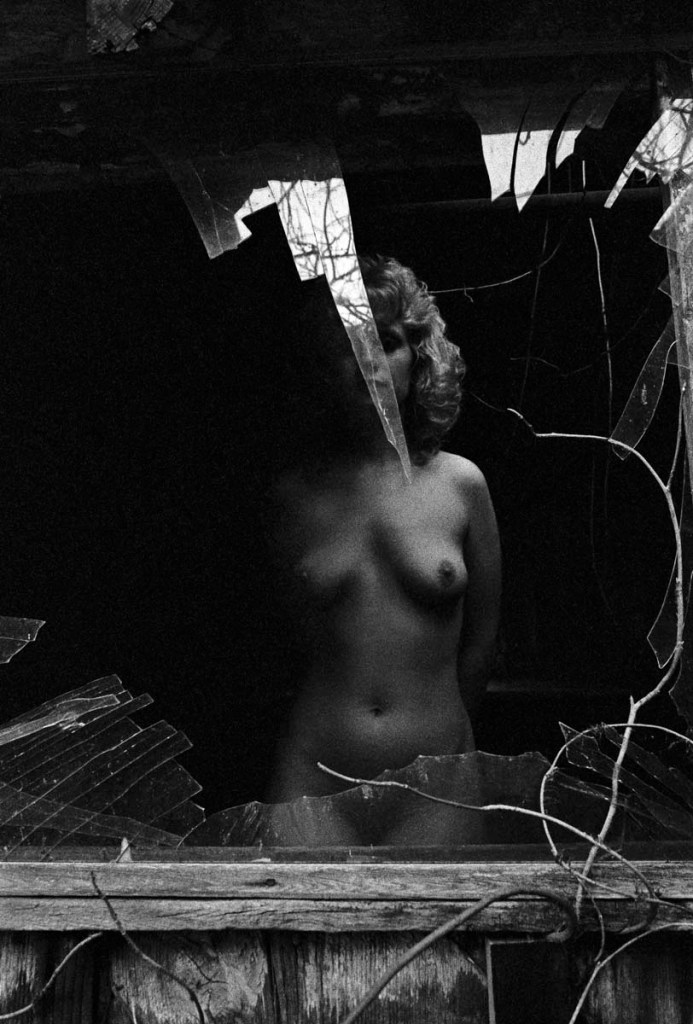
Image is Copyrighted.
 Sleeping Mind Photography