Erlebniskunst or “experience art” in German, is a philosophical concept that emphasizes the importance of the viewer’s experience in the appreciation of art. It was first developed by the philosopher Hans-Georg Gadamer in the 20th century. Gadamer argued that art is not simply an object to be contemplated, but rather a dynamic process of interaction between the work and the viewer.
From the Philosophy Dictionary of Arguments
Certain words peak my interest. I recently encountered the word Erlebniskunst in an article about art. I related to the concept behind it and wondered if and how it applies to photography.
All the research information that I was able to find came from philosophy articles that stem from the original concept developed by Hans-Georg Gadamer who wrote:
“the power of the work of art suddenly tears the person experiencing it out of the context of his life, yet relates him back to the whole of his existence.”
I noted in a previous post titled “Creators and Observers” that I believed that we need more observers who are sensitive to aesthetic qualities in photographs and that there should be a visual/emotional relationship between the creator and the observer. A photograph that connects with a viewer should be able to create a spell on the observer. Sometimes an image will leave the observer speechless and stir emotions and aesthetic senses.
I feel the “art of experience” can apply to viewers of both photographs and the other arts. The observer must feel the emotional connection which has primacy over what is seen. Unfortunately, many viewers only see what is on the surface of the image. Some pictures will speak to you if you are receptive and allow them to do so.
“Art is only through feeling, so alive and sensitive that the picture is as the breath out of the mouth, but coming from the heart.”—Abraham Walkowitz
My photograph “Repose” was part of a gallery show. A viewer was having an emotional connection with the work and started telling me what she was feeling. I asked Rachel if she could write down the thoughts that she was experiencing.
“At first glance, “Repose” appears almost apocalyptic – the nude woman, staring blankly off into the distance, her partially curled body laying in a dormant cornfield, the sepia tones of the photograph adding to the eeriness. A quick assumption could be that the figure is dead, a simple conclusion placed together by the drained color palette and lifeless cornstalks. The composition of the picture plane with it’s single point perspective makes the viewer feel as though he/she is physically in the space. The viewer is no longer only an observer, but now also a participant. It’s this play with composition that signals the viewer to take pause, and examine the photograph longer. The figure, and older woman, lays in a pose reminiscent of a relaxed fetal position — a posture associated with new life. However, everything else in this photograph recalls aging, or nearing a state of hibernation, dormancy or death. The field the figure lays in has clearly been harvested, indicating an end to the growing season and an approach toward winter. Winter is often thought of as ‘the end’ of the cycle of seasons: plants fade, animals hibernate, and humans retreat in their own ways, waiting for spring to come when life will re-emerge and be re-born. Winter brings stillness. This stillness is expressed in “Repose.” It’s the stillness that allows the viewer to reflect. While, “Repose” is clearly a photographic commentary on aging, it’s not one of hopelessness. Like the seasons, the figure has lived through seasons of her own life; and in the stillness the viewer recognizes the beauty in her age and the life that she still has left. Moreover, “Repose” causes the viewer to think about his or her own mortality and life. It works as a memento mori of sorts — but a reminder that life continues, rather than a reminder of death.”
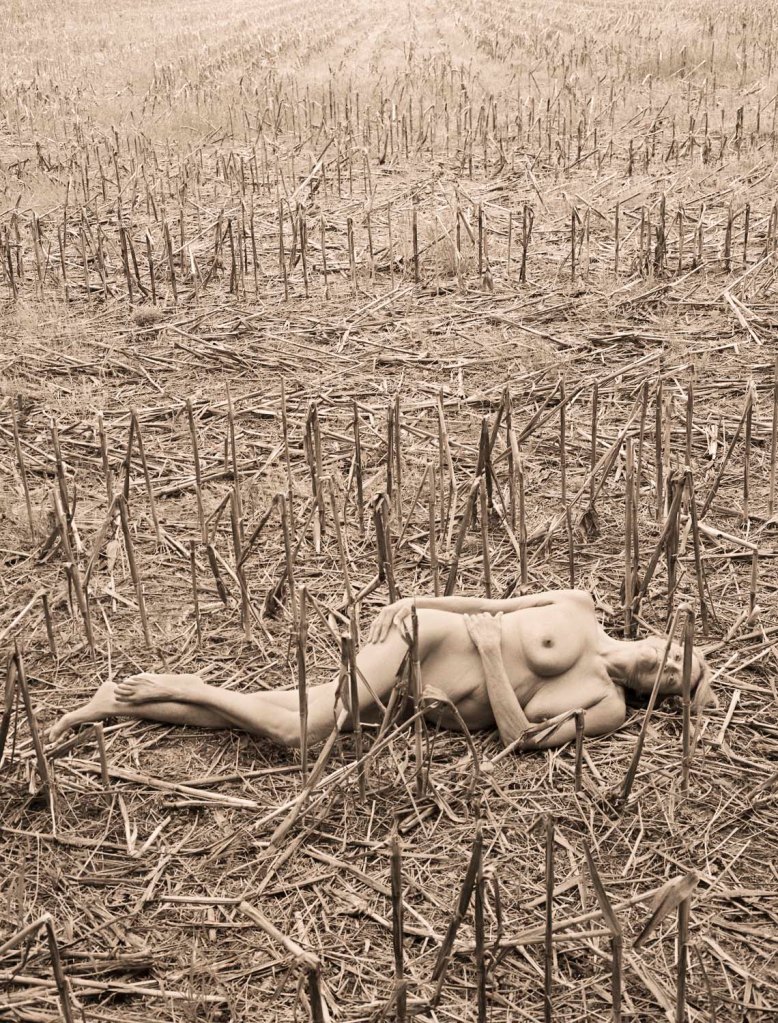
Repose (all images copyrighted)
 Sleeping Mind Photography