Balthus and Me

Balthus, the artist, was a fascinating character. Nicholas Fox Weber, the writer, wrote an excellent biography on the amazing life of Balthus. The book “Balthus-A Biography” was published in 1999 when Balthus was still alive and Weber was able to interview him over a number of years.

I find that the paintings by Balthus are evocative, provocative, erotic and dreamlike. I felt an immediate connection with his work. Even though his paintings and my photographs are very different, they both elicit similar responses from viewers especially concerning the nudes. 

Balthus and I react to probing questions about our work with similar responses. When questioned about the meaning or message of a particular painting, a Balthus response was: “It’s absolutely not symbolic. The meaning of the painting is the painting.”

When Weber asked him about the painting “The Room” Balthus replied that “The Room” is simply a painting of a nude in a room with a girl at the window.

Another Balthus response when questioned about eroticism in his paintings was: “The problem is that everyone sees eroticism. My pictures aren’t erotic. The problem is psychoanalysis.”

Quotes from my writings reflect similar reactions to criticisms of my photographs. In 1997, I wrote a “Personal Statement” as an introduction to a book featuring my early nude work where I wrote: “A common reaction to my work is that the images are disturbing. The images are not disturbing to me. They are simply expressions.”

Another quote which is from my “Artist Statement” is: “I make my work without a social or political agenda. There is no message or hidden purpose. The photograph is the photograph. What the viewer sees and interprets is out of my control.”

While reading the book on Balthus, I found the similarities between our responses and thinking processes to be uncanny. Also, the relentless questioning of Balthus’s artistic intent by Weber reminded me of my graduate school professor, John Weiss, and his agitation with my responses regarding my work. His normal reaction was that I should take more responsibility for my photographs instead of denying intent. Neither Weber or Weiss could accept either of our simplistic responses to our work. They both pushed for more information in an accusatory manner as if we were taking the easy way out instead of searching for meanings in our work. For me the information that was wanted was neither available nor important to me.

An observation made by Claus von Bülow, a friend of Balthus, was that he felt Balthus more as a perpetual voyeur of women that as an active lover. When I photograph a model, I view it as a business relationship and not a chance for a romantic relationship. But I would say that I am a voyeur of women. The difference between Balthus and myself is that he preferred young girls where my preference is to photograph older mature women.

Another difference is that I believe my unconscious plays a role in my image making whereas Balthus vehemently denied any influence from the unconscious. 

For me, the work of Balthus stimulated areas of my brain that connected with his paintings even though I cannot verbally say what this connection is. As Balthus said “the painting is the painting.” The visual elements of the painted canvas are all that mattered to him.

Here is an older photograph from my Collector Series. For me, it is simply a woman standing in back of a window behind a broken shard of glass. The viewer can make more out of it if they wish.
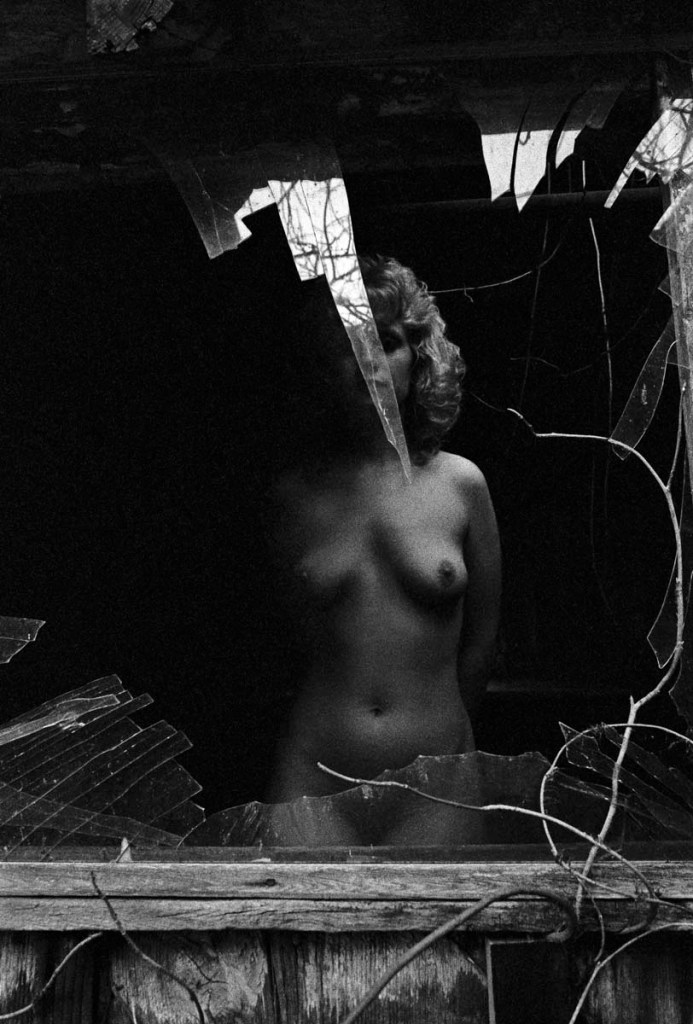
Image is Copyrighted.

Olympia by Manet

Here I am standing inside the Metropolitan Museum of Art in the gallery of the Manet/Degas show observing the painting “Olympia” by the artist Édouard Manet. It is a large painting measuring 51.1 inches by 74.8 inches. Completed in 1863, it is a picture of a naked red-headed lady with lilly-white skin lying on a rumpled bed with a black maid standing behind her holding a bouquet of flowers and a surprised looking black cat standing on the end of the bed.

A great deal of information has been written about how scandalous the painting was when it was exhibited at the 1865 Paris Salon and how it was instrumental in ushering in the age of modern art. In today’s world the idea of it being scandalous is at best quaint. But that is not what I want to write about.

I was standing in front of the painting when two ladies passed briskly in front of me giving a cursory glance at the painting with one saying to the other “that’s pretty” as they quickly moved on. Art appreciation at it best. For me, I could not stop looking at the painting. The scale of the painting along with the subject matter demanded attention. While closely observing every square inch of the canvas, I began to feel I was part of the scene as if I was traveling through time. I felt as if I was standing in the room depicted in the painting but I was a photographer working with the two models. I had asked Victorine to lay on the bed. She is naked except for a flower in her hair, a bracelet on her right wrist, a black ribbon around her neck, earrings and slip-on shoes. She came to the modeling session wearing these items and I could see no reason she should remove them. I usually go with serendipity. The other model, Laure, is wearing a pink dress with a white collar, a pink hair covering and holding a large bouquet of flowers wrapped with white paper. The thing that visually stands out on her are the red dangly earrings but since her head is turned only one is visibly hanging from her left ear. It definitely held my attention. I thought about having her remove it since it was distracting but again that is how she came to the modeling session and sometimes my meddling can detract from the composition.

When Victorine positioned herself on the bed, she just naturally posed in a comfortable position with legs crossed at the ankles and her hands finding positions that look natural and relaxed. It was just a coincidence that her left hand covered her pudendum. Her torso is propped up on the bed with pillows. The white sheets are messy and rumpled but again I don’t like to tamper with such details-I take it as it is. I asked both models to look at me which I thought would be best. Victorine looked at me but Laure made a questioning glance toward Victorine as if to ask a question. I liked the way she glanced and asked her to continue with that pose. Before freezing the image for posterity, a black cat unexpectedly appeared and jumped onto the bed looking directly at me. At first, I wanted to get the cat out of the picture but decided that it filled in that empty corner and proceeded to take the final picture. As I began fading away, I thought that Édouard would be happy with my photograph.

I slowly began to hear voices and saw people around me and realized I had returned to the museum looking at “Olympia”. Even though “Olympia” is a painting, I related to it as a photograph. First, it is a nude and a large portion of my photographic work is centered on the nude. Second, it is very naturalistic in appearance and has a relaxed demeanor. Third, there is a randomness to the composition including the models’ poses, the objects, the background, and the inclusion of the unexpected (the cat). These elements show up in some of my best work. 

Of course, the above account is pure speculation on my part but there is some basis that these events could be rooted in photography. I believe photography’s role may have had some significance. The painting has a modern feel to it and although no photographs have been connected to “Olympia” it seems to have a genetic relationship to photography.

It is known that Manet did use photographs for some of his paintings and etchings including “The Execution of the Emperor Maximilian” and several portraits. Some of his paintings included photographic nuances associated with light and dark areas of compositions. Historically, film initially had difficulty recording middle tones which resulted in high contrast photos. Paintings using such photographs as guides emphasized such characteristics.

Manet was not a stranger to photography (I saw him referred to as an amateur photographer) and like other painters he used photographs to help in his artistic vision.

But does it matter. It really is about the painting. What you see and feel when viewing it. The painting pulled me right into it and I felt I was there in 1863 recording the scene on film. Perhaps I did and Édouard Manet used my image to help create “Olympia.”

References: The Artist and the Camera-Degas to Picasso

     Art and Photography

“Olympia” by Édouard Manet