“he, too, was one of those who pursue life as it flees, a hunter of the unattainable, like the takers of snapshots.”
From the short story “Adventures of a Photographer” by Italo Calvino
I am not sure why photography was so associated with hunting where words such as, photo shoot, snapshot, and capture, are part of the language of photography. Historically (1800’s), the snapshot was a term used in hunting to describe a quick shot. It may have also been the sound that hunting rifles made when fired. Personally, I do not like the word “hunter” which makes me think of killing. I think most photographers are harmless. Why not just use the word photographer. In a previous post “Psychology and Photography” I stated: “I am not a hunter and I do not hunt with my camera but am constantly searching for new avenues for my photography.” The search for the unattainable is a valid characteristic of many photographers. Despite the many failures, the drive to keep looking and photographing seems to be instinctual.
I am a photographer in search of the unattainable. I am always searching for the next great photo. It is my hope that I will get one “exceptional” image during a photo session. Basic elements such as composition, lighting, exposure and focus must be satisfied but more important is whether the image visually excites me. Does it have unique visual qualities such as an interesting juxtaposition, a certain pose or look, a special element that is an unanticipated surprise. The image must make me want to look. Unfortunately, such photos are rare but that doesn’t stop me from my photo searching. The photograph must visually rise above my other images.
It is an innate obsessiveness to find something or someone worthy of photographing. Even when I do not have a camera with me, I still see life in photographic terms. For me, there are unlimited possibilities.
Flo Fox died on March 2, 2025. I had never heard of her but she apparently was a prolific street photographer in New York City. What caught my attention in her obituary was the fact that she was born blind in one eye. She felt it was an advantage as a photographer because she didn’t have to close the blind eye when she took a photo and that she did not see three-dimensionally (3D) which meant she saw the scene as the image would appear as a photo print in two dimensions (2D).
I can relate. I was not born blind but beginning as a teenager I have lost most of my vision in one eye. Besides seeing the world in two dimensions, there is also a loss of depth perception. Like Flo Fox, despite the limitations to my vision, I see the positive side of the handicap. I do see the world as flat and my photographs look exactly as I saw the composition through the camera viewfinder.
It is believed that the artist Rembrandt may have been stereoblind which would have aided him in flattening what he saw for the production of 2D works. Scientists have suggested that more artists seem to have stereoblindness when compared with a sample of people with stereo acuteness (normal stereo vision).
Stereoblindness is defined as the inability to see in 3D using stereopsis, or stereo vision, resulting in an inability to perceive stereoscopic depth by combining and comparing images from the two eyes. Individuals with only one functioning eye have this condition by definition since the visual input from the second eye does not exist.
I have had extremely limited vision in one eye for so long that I cannot remember what a 3D world looks like. I don’t know whether this has made me a better photographer or is it something that I had to adjust to and my photographic output would have been the same.
Erlebniskunst or “experience art” in German, is a philosophical concept that emphasizes the importance of the viewer’s experience in the appreciation of art. It was first developed by the philosopher Hans-Georg Gadamer in the 20th century. Gadamer argued that art is not simply an object to be contemplated, but rather a dynamic process of interaction between the work and the viewer.
From the Philosophy Dictionary of Arguments
Certain words peak my interest. I recently encountered the word Erlebniskunst in an article about art. I related to the concept behind it and wondered if and how it applies to photography.
All the research information that I was able to find came from philosophy articles that stem from the original concept developed by Hans-Georg Gadamer who wrote:
“the power of the work of art suddenly tears the person experiencing it out of the context of his life, yet relates him back to the whole of his existence.”
I noted in a previous post titled “Creators and Observers” that I believed that we need more observers who are sensitive to aesthetic qualities in photographs and that there should be a visual/emotional relationship between the creator and the observer. A photograph that connects with a viewer should be able to create a spell on the observer. Sometimes an image will leave the observer speechless and stir emotions and aesthetic senses.
I feel the “art of experience” can apply to viewers of both photographs and the other arts. The observer must feel the emotional connection which has primacy over what is seen. Unfortunately, many viewers only see what is on the surface of the image. Some pictures will speak to you if you are receptive and allow them to do so.
“Art is only through feeling, so alive and sensitive that the picture is as the breath out of the mouth, but coming from the heart.”—Abraham Walkowitz
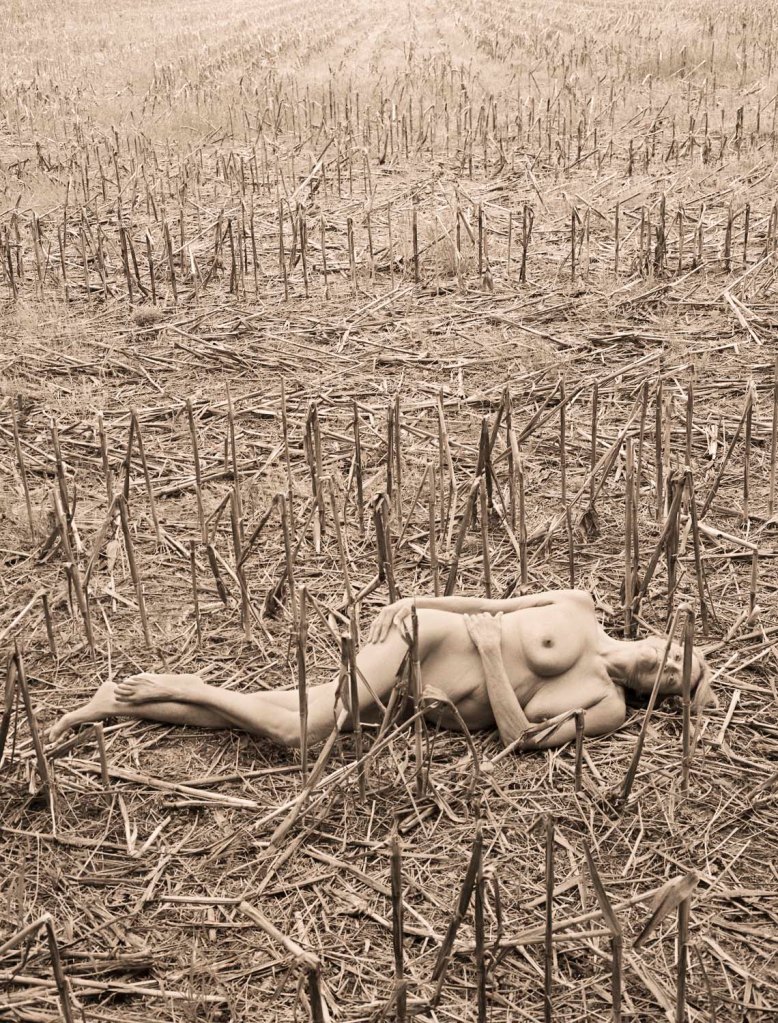
My photograph “Repose” was part of a gallery show. A viewer was having an emotional connection with the work and started telling me what she was feeling. I asked Rachel if she could write down the thoughts that she was experiencing.
“At first glance, “Repose” appears almost apocalyptic – the nude woman, staring blankly off into the distance, her partially curled body laying in a dormant cornfield, the sepia tones of the photograph adding to the eeriness. A quick assumption could be that the figure is dead, a simple conclusion placed together by the drained color palette and lifeless cornstalks. The composition of the picture plane with it’s single point perspective makes the viewer feel as though he/she is physically in the space. The viewer is no longer only an observer, but now also a participant. It’s this play with composition that signals the viewer to take pause, and examine the photograph longer. The figure, and older woman, lays in a pose reminiscent of a relaxed fetal position — a posture associated with new life. However, everything else in this photograph recalls aging, or nearing a state of hibernation, dormancy or death. The field the figure lays in has clearly been harvested, indicating an end to the growing season and an approach toward winter. Winter is often thought of as ‘the end’ of the cycle of seasons: plants fade, animals hibernate, and humans retreat in their own ways, waiting for spring to come when life will re-emerge and be re-born. Winter brings stillness. This stillness is expressed in “Repose.” It’s the stillness that allows the viewer to reflect. While, “Repose” is clearly a photographic commentary on aging, it’s not one of hopelessness. Like the seasons, the figure has lived through seasons of her own life; and in the stillness the viewer recognizes the beauty in her age and the life that she still has left. Moreover, “Repose” causes the viewer to think about his or her own mortality and life. It works as a memento mori of sorts — but a reminder that life continues, rather than a reminder of death.”
I keep coming back to the topic of digital technology and its relationship to photography. I believe technology has had more of a negative impact than a positive one on the quality of fine art photographs made today and going back to the beginning of this century. I refer to this period of time as the “age of digital interruption”. In the photography historical timeline, I believe this period will be viewed as a step backward or at best a period of stagnation.
Part of the problem is technology itself and how it has affected concentration that is needed to create photographs that rise above the mundane. I also blame social media for dumbing down the quality of images. Visual acuity has been dampened by the impersonal “likes” and “thumbs up” given by viewers which then give a false sense of importance to the image maker and the quality of their photographs. The inability to focus attention and the lack of concentration may also be major contributors to the uninspired output of photographs. Today’s digital mind doesn’t want to spend time looking, thinking and interpreting images. It wants a steady stream of information and the ability to make a cursory comment. Volume is more important than quality and personal introspection.
I still make what I think are very creative photographs using digital photography but I sometimes feel that my film and darkroom work was better. The question is why. What is the impact of digital versus film photography? Here are a few thoughts.
With digital you can expose hundreds of frames in a very short time whereas with film photography you were limited by the number of frames on a roll. I believe film required more thought and care because of the cost of each roll and the cost of processing. Visual care was important when working with film. A photographer did not want to waste film. With a digital camera the only limit is the capacity of the memory card. Expose many frames and hope there is one good image.
In film days, I think it was more important to get the exposure correct. There was limited latitude in making corrections in the darkroom to a print. In digital, a photographer can be a little lazy knowing substantial changes can be made during the processing stage.
When using film there was no choice but to pay attention to what was in front of the camera. You could keep your eye on the subject. Concentration was not interrupted. I find that digital photographers like to take a peek at the screen to see what they got. They will even show the subject. This detracts from the actual picture making. That quick peep shifts the photographers’ vision from the subject to the screen and then the attention has to shift back to the subject. I have seen photographers doing this frequently. Continuity is lost.
A digital camera is overly complicated and the processing software is even worse. My current digital camera manual is 500 pages thick. My film camera manual is much simpler.
One of the things that I like about many of my older black and white film images is the play of light areas against dark areas. Sometimes the shadows are devoid of detail and the highlights can be a little washed out. This kind of chiaroscuro is missing from my digital work. It is also missing from most of the digital work of others that I have seen.
Digital is easy to blame but blame can also be placed on photographers and how they use the technology. One of the things that digital has done is to make image exposures almost perfect (even in very dim light) and if not perfect at the time of capture then this can easily be refined during the development phase. There is a sameness and a visual monotony to the photos. The latest digital sensors open up the shadows and tame the highlights. The other aspect of digital where the photographer can be blamed is the use of software that alters the way an image looks. Digital images can be made to look like film or textures can be added to add a painterly touch. Unfortunately, if an image is bland to start with, adding a special effect won’t make it better.
It is up to photographers to keep technology under control. Just because a programmer can write code to make a razzle-dazzle photo feature does not mean a photographer has to use it. Use only the essential digital tools needed to make a finished print. One that shows your personal expression.
 Sleeping Mind Photography