Erlebniskunst

Erlebniskunst or “experience art” in German, is a philosophical concept that emphasizes the importance of the viewer’s experience in the appreciation of art. It was first developed by the philosopher Hans-Georg Gadamer in the 20th century. Gadamer argued that art is not simply an object to be contemplated, but rather a dynamic process of interaction between the work and the viewer.

From the Philosophy Dictionary of Arguments

Certain words peak my interest. I recently encountered the word Erlebniskunst in an article about art. I related to the concept behind it and wondered if and how it applies to photography.

All the research information that I was able to find came from philosophy articles that stem from the original concept developed by Hans-Georg Gadamer who wrote:

“the power of the work of art suddenly tears the person experiencing it out of the context of his life, yet relates him back to the whole of his existence.”

I noted in a previous post titled “Creators and Observers” that I believed that we need more observers who are sensitive to aesthetic qualities in photographs and that there should be a visual/emotional relationship between the creator and the observer. A photograph that connects with a viewer should be able to create a spell on the observer. Sometimes an image will leave the observer speechless and stir emotions and aesthetic senses.

I feel the “art of experience” can apply to viewers of both photographs and the other arts. The observer must feel the emotional connection which has primacy over what is seen. Unfortunately, many viewers only see what is on the surface of the image. Some pictures will speak to you if you are receptive and allow them to do so.

“Art is only through feeling, so alive and sensitive that the picture is as the breath out of the mouth, but coming from the heart.”—Abraham Walkowitz

My photograph “Repose” was part of a gallery show. A viewer was having an emotional connection with the work and started telling me what she was feeling. I asked Rachel if she could write down the thoughts that she was experiencing.

“At first glance, “Repose” appears almost apocalyptic – the nude woman, staring blankly off into the distance, her partially curled body laying in a dormant cornfield, the sepia tones of the photograph adding to the eeriness. A quick assumption could be that the figure is dead, a simple conclusion placed together by the drained color palette and lifeless cornstalks. The composition of the picture plane with it’s single point perspective makes the viewer feel as though he/she is physically in the space. The viewer is no longer only an observer, but now also a participant. It’s this play with composition that signals the viewer to take pause, and examine the photograph longer. The figure, and older woman, lays in a pose reminiscent of a relaxed fetal position — a posture associated with new life. However, everything else in this photograph recalls aging, or nearing a state of hibernation, dormancy or death. The field the figure lays in has clearly been harvested, indicating an end to the growing season and an approach toward winter. Winter is often thought of as ‘the end’ of the cycle of seasons: plants fade, animals hibernate, and humans retreat in their own ways, waiting for spring to come when life will re-emerge and be re-born. Winter brings stillness. This stillness is expressed in “Repose.” It’s the stillness that allows the viewer to reflect. While, “Repose” is clearly a photographic commentary on aging, it’s not one of hopelessness. Like the seasons, the figure has lived through seasons of her own life; and in the stillness the viewer recognizes the beauty in her age and the life that she still has left. Moreover, “Repose” causes the viewer to think about his or her own mortality and life. It works as a memento mori of sorts — but a reminder that life continues, rather than a reminder of death.”
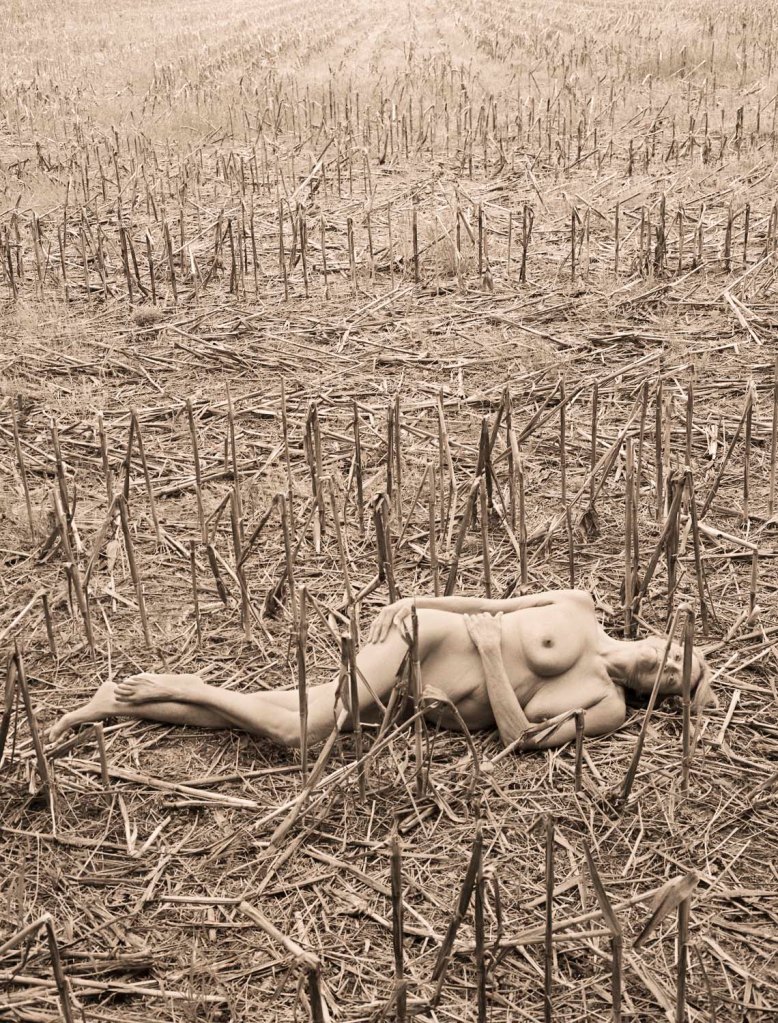
Repose (all images copyrighted)

Stranglehold of Relevance

“The idea of the work of art as an imaginative achievement to which the audience freely responds is now too often replaced by the assumption that a work of art should promote a particular idea or ideology, or perform some clearly defined civic or community service.”

“I want us to release art from the stranglehold of relevance—from the insistence that works of art, whether classic or contemporary, are validated (or invalidated) by the extent to which they line up (or fail to line up with) our current social and political concerns.”  

From the book Authority and Freedom by Jed Perl—pages 16 and 19.

I believe that today’s photography is being choked to death in this “stranglehold of relevance.” So many of the photographic images I see today are centered on “race, gender and sexual orientation.” Museums, galleries and the media are so focused on these current trends that they are tripping over each other to obtain appropriate work. As a result, many of the photographers today choose their subject matter to appeal to these controllers of the image gateways in the hope they will be recognized. Pity the poor stand-a-lone photograph, even if it is far superior than the trendy image, and the photographer who created it. Too bad if you and your photographs don’t fit into the theme du jour.

Perhaps it is time that the image gatekeepers swing the pendulum back to a more balanced state of photography where all photography does not have to be relevant and the best images have a chance to be recognized.

I wonder how many of the master photographers of the past, who have been highly recognized by the photography world, would have fared in the current photography environment.

For example, the photographer Jerry Uelsmann died on April 4, 2022. His images were independent dreamscapes that are difficult to classify. They verged on the surreal and were created by combining multiple negatives in the darkroom. In 1967, he had his first solo show at the Museum of Modern Art in New York City and that same year he was featured in Aperture Magazine (issue 13:3, 1967). Today, I doubt that the world would even hear of Jerry Uelsmann and, with its current subject emphasis, Aperture would not have featured him (much to the chagrin of Minor White who founded and was the editor of Aperture.) 

Let us free photography from the current constraints and give it room to breathe.

Classic Post 3–Creators and Observers

I create my photographs but I do not interpret them. That is not my job. I let the observer do that. 

It is the observers’ job to discover their own interpretation. It is my hope that the viewer will emotionally connect with the image.

Today, we are visually saturated and I am concerned that the public does not really look at an image and try to discover what it is about. Simply indicating a social media “like” is not enough. We need more observers who are sensitive to aesthetic qualities in photographs.

I am also concerned that many of today’s photographers do not make images that go beyond the superficial surface of the subject whether it is animate or inanimate. Visually, many of the current images that I see lack depth and do not require anything more than a cursory glance. I subscribe to Aperture magazine and have noticed that the old adage that “a picture is worth a thousand words” should be changed to “it takes a thousand words to describe a photograph.” I now see many photos that cannot stand alone or even in a photo series without needing a lengthy critique which may vaguely explain or try to explain the significance of the work. It seems to me that photographers and writers are trying very hard to impress with their images and writings. Perhaps photographers lack the “vision” to create exceptional images and the writers use a lot of mumbo-jumbo to make themselves sound knowledgeable. We need more creators who see beyond the visually mundane.

There should be a visual relationship between the creator and the observer. The best photographs should create a spell on the observer.

Kant wrote the following about creative talent and genius. The talent/genius “does not know himself how he has come by his ideas; and he has not the power to devise the like at pleasure, or in accordance with a plan, and to communicate it to others in precepts that will enable them to produce similar products.”

There are photographs that I am unsure of how I created them and certainly will never be able to replicate. The technique of photography can be taught but the talent arises from the inner being.

The observer may experience similar emotions when viewing a photograph. The French have a phrase je ne sais quoi that refers to something that cannot be adequately described or expressed. Sometimes an image will leave the observer speechless and stir emotions and aesthetic senses.

The source of this emotional stirring and the connection to an image may be elusive and unexplainable. There are times when as an observer I relate to an image in such a way that verbal expression is neither possible nor necessary. I like numinous images-those that contain an element of mystery and appeal to the aesthetic sense.

It seems that the world is becoming more divided into creators and observers-those who make images and those who passively look. Unfortunately, there seems to be a dilution in talented creators and a diminished visual awareness of viewers. Some of this can be blamed on the barrage of images that the public is exposed to through modern technology but also blame can be directed to a lack of emphasis on visual literacy.

Mind Wandering

I seem to have an innate desire to get to the root of creativity even though I know it is an impossible task. I have previously written essays on the subject of creativity, especially as it relates to photography. The most recent book I read is Stolen Focus-Why You Can’t Pay Attention and How to Think Deeply Again by Johann Hari. Focus is not used as the photography term but the thinking term for clear perception and understanding.

Hari uses the phrase “mind wandering” which can result when the external stimuli are turned off and you can actually let your brain drift and think without interruption. The difficult part is that you have to stop the “noise.” You have to give your mind room and space to process thoughts. This means you have to slow down the input to your senses. A major benefit of turning off the hyper-world is regaining the ability to allow for mind wandering which can open the door for creativity. 

“Creativity is not (where you create) some new thing that’s emerged from your brain. It’s a new association between two things that were already there.” –Stolen Focus, page 96.

I question how one can be creative when trying to process all the external stimuli that bombards the senses non-stop. Unfortunately, many people are so conditioned by this constant “noise” that they find it difficult to turn off the hyper-world. How many people can turn off their electronic devices for a day without feeling anxious?

Whether you are a photographer or not, give your mind room to wander, slow down the unnecessary external stimulation and take the time to observe and interact with your environment. 

Uprooted Series (in camera double exposure on film)

Looking at the World at a Slight Angle

John Banville in his book April in Spain uses the phrase “looking at the world at a slight angle.” It resonated with me to the extent that I jotted it on a small scrap of paper and ruminated about how many of my best images were created when things were viewed at a slight angle. This does not mean that you walk around with your head cocked to one side to change your angle of view but that your skills of perception are sensitive to something unique, maybe an unusual juxtaposition, or “something never seen before”—a challenge that I assigned my photo students. Of course, this concept of “looking at the world at a slight angle” is not something that can be easily turned off and on.

As I have previously written in essays, I believe the unconscious plays a major role in this ability to see at a slight angle. As a photographer, the term I use when my vision blends with the deep layers inside my brain is the “period of intensive perception.” This is where I experience being in a state of mind that is momentarily removed from reality and my visual sensitivity reaches a new level. Everything seems to slow down and there is an increased level of clarity. I see things that I did not see moments earlier. This is when creativity is elevated which results in some of my best work. Unfortunately, it is elusive. It is easy to talk and write about but most difficult to execute.

Introduction

This is a reiteration of Sleeping Mind Photography-a blog I maintained for six years. It was an active site until 2020 at which time I decided to close it. I had lost my interest and had stopped even my irregular posting routine.

So what changed. I continued to write essays and self-published collections of my photographs in books. I will be posting some of this material over the coming months. I will also select some old posts that I thought were interesting and reissue them.

This blog is not about selling or promoting anything and is not a money-making venture. I will post a few images to help add some visual interest but the blog is not intended to be a gallery to promote my work. It will be about my observations, my experience, the psychology of photography, helpful hints, and perhaps a curmudgeon gripe or two. I may make mention of a piece of equipment but this is not a review site. The blog is solely an attempt by me to organize and record my thoughts. Perhaps a reader may find inspiration or motivation from my writing.

Welcome old and new readers.

Inspiration for the Blog Title

“The machinery for dreaming planted in the human brain was not planted for nothing. That faculty, in alliance with the mystery of darkness, is the one great tube through which man communicates with the shadowy. And the dreaming organ, in connection with the heart, the eye, and the ear, composes the magnificent apparatus which forces the infinite into the chambers of the human brain, and throws dark reflections from eternities below all life upon the mirrors of that mysterious camera obscura–the sleeping mind.” -Thomas De Quincey