The Search for the Unattainable

“he, too, was one of those who pursue life as it flees, a hunter of the unattainable, like the takers of snapshots.”

            From the short story “Adventures of a Photographer” by Italo Calvino

I am not sure why photography was so associated with hunting where words such as, photo shoot, snapshot, and capture, are part of the language of photography. Historically (1800’s), the snapshot was a term used in hunting to describe a quick shot. It may have also been the sound that hunting rifles made when fired. Personally, I do not like the word “hunter” which makes me think of killing. I think most photographers are harmless. Why not just use the word photographer. In a previous post “Psychology and Photography” I stated: “I am not a hunter and I do not hunt with my camera but am constantly searching for new avenues for my photography.”  The search for the unattainable is a valid characteristic of many photographers. Despite the many failures, the drive to keep looking and photographing seems to be instinctual.

I am a photographer in search of the unattainable. I am always searching for the next great photo. It is my hope that I will get one “exceptional” image during a photo session. Basic elements such as composition, lighting, exposure and focus must be satisfied but more important is whether the image visually excites me. Does it have unique visual qualities such as an interesting juxtaposition, a certain pose or look, a special element that is an unanticipated surprise. The image must make me want to look. Unfortunately, such photos are rare but that doesn’t stop me from my photo searching. The photograph must visually rise above my other images.

It is an innate obsessiveness to find something or someone worthy of photographing. Even when I do not have a camera with me, I still see life in photographic terms. For me, there are unlimited possibilities. 

Morning Light (all photos are copyrighted)

Tactile Aspects of Analog Photography

Analog photography is very tactual. I recently was loading large format sheet film into 8 by 10inch film holders which I use in my pinhole camera. It is a very tactile process since it has to be done in total darkness and involves the sense of touch. The film has notches in one of the corners which identify the type of film and also indicates which side is the emulsion side (which has to face out). The dark slide which covers the unexposed film until ready to be used has little bumps along the silver side the top edge which indicates that the film under that side of the slide is unexposed and ready to be used. The other side is black with no notches and this indicates that this film has been exposed. Sounds complicated but the point is that touch is integral to the process.

After I was done loading the film holders, I realized how much I enjoy the tactile sensations experienced in analog photography. The tactile sensations continue through taking the photographs and processing the negatives. Touch is involved in every step.

Whether you are using large format film, medium format or 35mm, touch is essential. Loading exposed film in the dark into a film developing tank in preparation for processing requires touch and dexterity. I use stainless steel developing tanks and reels and I find that the cool smooth touch of the metal is pleasurable. 

It is obvious that analog photography has many more opportunities for tactile stimulation than digital photography. I also use digital capture and processing. Sight rather than touch is the most valuable sense in digital photography. Loading and unloading a memory card along with using a computer screen, a mouse and keyboard is basically the tactual highlights. Touching photo paper is the most tactual thing I do in digital.

Over the decades, I feel that my analog work is far better than my best digital work. I recently attended the NiNPAH (Nude in Nature Photo Art Haven) event where I worked with two models for two hours each. I decided to only use black and white film. I exposed two rolls of 36 exposures with each model which is my usual shooting pace. When working in black and white, I visually interpret the scene into a gray scale. I even prefer to watch old television shows and movies that were filmed in glorious black and white. For me, color photography requires a different mindset and is visually less fulfilling than black and white photography.

For me, the tactility of analog photography has no comparison with digital photography. Perhaps that is why there has recently been more interest in analog. People want more of a hands-on approach. I admit that there are many ways to mess up throughout the analog process. I have made what is probably every mistake possible but that is part of the challenge and the results are rewarding.

I can see why most people prefer digital. It is more full-proof (although I have managed to find ways to screw up).

My final argument for analog is that film cameras are less complicated than digital. My Nikon F100 film camera manual has 111 pages. My Fujifilm 645i medium format film camera is 39 pages. My Nikon D750 digital camera manual is 504 pages. In my analog influenced opinion, digital did not make photography easier.

Digital photography is here to stay for now. I only hope that a small space will continue to exist for the few who still use analog photography and value its tactility.

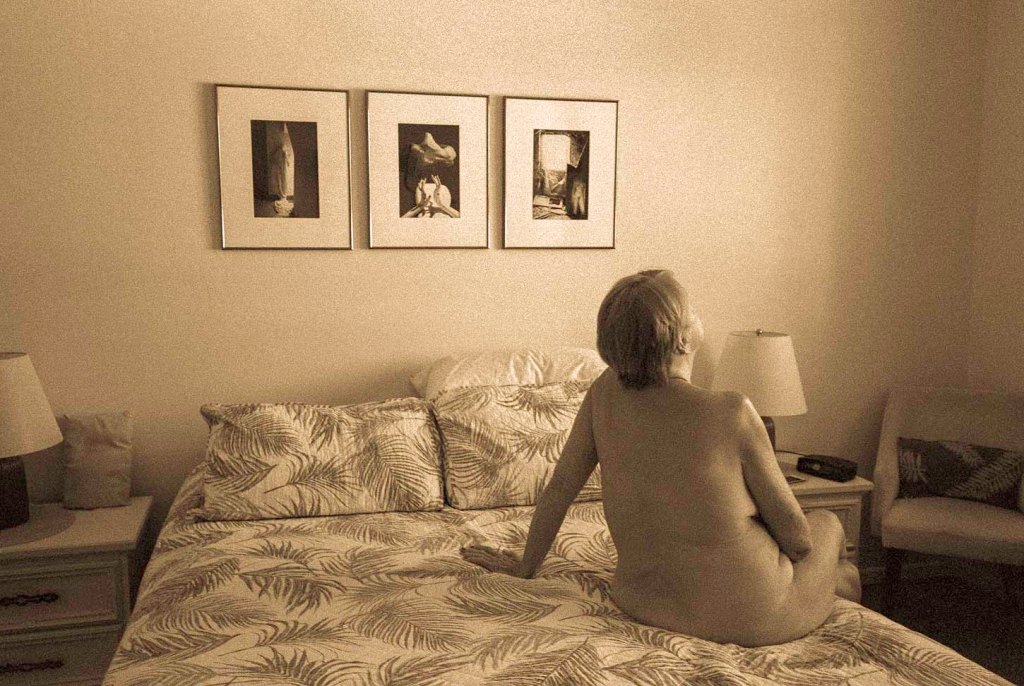
A recent black and white photograph. All images copyrighted.

The Age of Digital Interruption and the Impact on Photography

I keep coming back to the topic of digital technology and its relationship to photography. I believe technology has had more of a negative impact than a positive one on the quality of fine art photographs made today and going back to the beginning of this century. I refer to this period of time as the “age of digital interruption”. In the photography historical timeline, I believe  this period will be viewed as a step backward or at best a period of stagnation.

Part of the problem is technology itself and how it has affected concentration that is needed to create photographs that rise above the mundane. I also blame social media for dumbing down the quality of images. Visual acuity has been dampened by the impersonal “likes” and “thumbs up” given by viewers which then give a false sense of importance to the image maker and the quality of their photographs. The inability to focus attention and the lack of concentration may also be major contributors to the uninspired output of photographs. Today’s digital mind doesn’t want to spend time looking, thinking and interpreting images. It wants a steady stream of information and the ability to make a cursory comment. Volume is more important than quality and personal introspection.

I still make what I think are very creative photographs using digital photography but I sometimes feel that my film and darkroom work was better. The question is why. What is the impact of digital versus film photography? Here are a few thoughts.

With digital you can expose hundreds of frames in a very short time whereas with film photography you were limited by the number of frames on a roll. I believe film required more thought and care because of the cost of each roll and the cost of processing. Visual care was important when working with film. A photographer did not want to waste film. With a digital camera the only limit is the capacity of the memory card. Expose many frames and hope there is one good image.

In film days, I think it was more important to get the exposure correct.  There was limited latitude in making corrections in the darkroom to a print. In digital, a photographer can be a little lazy knowing substantial changes can be made during the processing stage.

When using film there was no choice but to pay attention to what was in front of the camera. You could keep your eye on the subject. Concentration was not interrupted. I find that digital photographers like to take a peek at the screen to see what they got. They will even show the subject. This detracts from the actual picture making. That quick peep shifts the photographers’ vision from the subject to the screen and then the attention has to shift back to the subject. I have seen photographers doing this frequently. Continuity is lost.

A digital camera is overly complicated and the processing software is even worse. My current digital camera manual is 500 pages thick. My film camera manual is much simpler.

One of the things that I like about many of my older black and white film images is the play of light areas against dark areas. Sometimes the shadows are devoid of detail and the highlights can be a little washed out. This kind of chiaroscuro is missing from my digital work. It is also missing from most of the digital work of others that I have seen.

Digital is easy to blame but blame can also be placed on photographers and how they use the technology. One of the things that digital has done is to make image exposures almost perfect (even in very dim light) and if not perfect at the time of capture then this can easily be refined during the development phase. There is a sameness and a visual monotony to the photos. The latest digital sensors open up the shadows and tame the highlights. The other aspect of digital where the photographer can be blamed is the use of software that alters the way an image looks. Digital images can be made to look like film or textures can be added to add a painterly touch. Unfortunately, if an image is bland to start with, adding a special effect won’t make it better.

It is up to photographers to keep technology under control. Just because a programmer can write code to make a razzle-dazzle photo feature does not mean a photographer has to use it. Use only the essential digital tools needed to make a finished print. One that shows your personal expression.