Psychology and Photography

I’ve been trying to write an essay about the relationship between psychology and photography for a long time. I would do some research, jot down a few notes and then put it aside to work on later. Sometimes years later. I think the issue for me was that I could never get a handle on the subject. I have written two essays addressing the unconscious and photography which is one aspect of psychology but I wanted to explore the overall subject in more detail. This paper may serve more as an outline because of the limited information available.

I was only able to find two papers by psychoanalysts that directly addressed the subject of psychology and photography. They are:

“Unconscious Motivations of the Amateur Photographer” by Carl Fulton Sulzberger,  M.D., 1955.

“Photography as an Extension of the Ego” by Donald B. Colson, 1979.

Both were focused on voyeurism and exhibitionism. They were also fixated on the aggressive implications of photography such as hunting and shooting. They referred to terms like shooting, capturing the image, hunting with a camera, photo shoot, and a single image as a shot.

In my case, I try not to use any of the above terms. I use “image” instead of shot and a photoshoot is a “photo session”. Instead of capturing a shot I will use “recording the image”. I am not a hunter and I do not hunt with my camera but may search to find new avenues for my photography.

When it comes to voyeurism, today it seems like everyone is a voyeur. The public is either making images for social media with their phones or they are looking at those images.  Voyeurism and exhibitionism seem to be the norm exhibited by many. Narcissism seems to be everywhere.

I am not particularly concerned with exhibiting my work. I’m a lazy exhibitionist. I create my work and store my photos in a box. Over the years, I have had a few shows, occasionally I will get a photo in a juried exhibition, or I will post some images to my blog. For my blog, the written word is more important than the photos. Also, creating new work is more important to me than showing work which can be time consuming.

Psychologically and photographically, it is as if my brain needs visual challenges. Can I find a new way of seeing something? When I make a photograph that extends my vision, I feel excitement, pleasure and personal satisfaction. This does not happen frequently but enough to keep me searching.

I think it is harder today to get a comprehensive understanding of the psychological aspects of photography. An analyst would be overwhelmed by the volume of data and the variety of people making images. I use the term “image maker” as opposed to “photographer” because I believe there is a significant difference between the two groups. Also, within each of these groups there is a range of ability and output. A photographer possesses a wide-ranging knowledge of photography and is a student of photo history. A photographer understands what makes a good photograph and is a harsh editor of their own work. A camera is a tool not a toy. The photographer uses photography as an expressive medium.

When it comes to psychology and photography, it seems that the subject contains many pieces that do not always fit together in one package. Photography plays many roles in the study of psychology and is used as a research tool in many studies. There is the psychology of aesthetics, the psychology of perception, and the psychology of color. Other than the few items outlined in this essay, there has been very little discussion about the broader subject of the psychology of photographers. Psychological terms such as the id, the ego, and the unconscious are used but practical connections to photographers are limited.

 Photography is very different today than it was when the two articles were written. Today, most people (the image-makers) photograph with their smartphone cameras. The volume of images has grown immensely. Photographers used to do their “magic” in darkrooms along with the mystery of using chemicals to develop film and make prints. Actual prints were shared between people instead of posting them on social media or showing them on a smartphone. Despite the articles being dated, there is still some valid information regarding psychology and photography.

Here are several additional thoughts mentioned in the essays:

“the camera becomes a bridge between conscious and unconscious, between the inner representational world and external reality.”—Donald B. Colson

“photographs serve to record multiple fleeting impressions which for most of us would be otherwise transient and soon lost to consciousness. For many photographers it may be the symbolic process in which that which is not conscious is made conscious, which comprises part of the appeal of photography.”—Donald B. Colson

“The created visual image, the visual forms which we make with our hands and eyes together, link the outer vision that explores the external world with the inner vision that shapes our felt experiences into symbols.”—Edward Steichen 1960

Pinhole Camera Photography

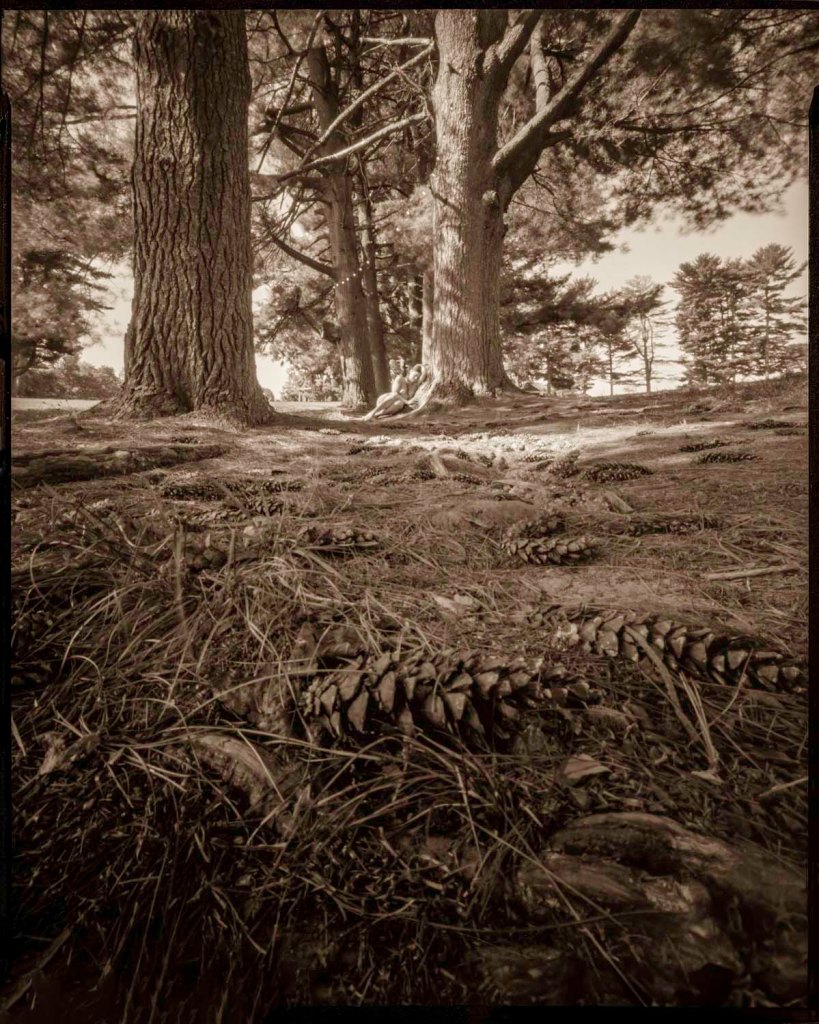
It has been two years since I last used my pinhole camera. I made the camera over twenty years ago. It is made out of plywood, a little bit of foam rubber insulation, and a lot of black duct tape to help make it light tight. I use old film holders that I load with 8-inch by 10-inch black and white sheet film. I used brass shim stock and a #9 sewing needle to make the actual pinhole. A friend gave me an old Packard-Ideal shutter that uses a pneumatic bulb attached to a tube to open and close the shutter. I installed small levels on two sides to help keep the camera level. I use a hand- held light meter to get an initial reading but also use a reciprocity chart to help compute a more accurate exposure time. Exposure times are usually in the 7-20 second range which means the subject must try not to move while the film is being exposed. Film has become very costly. A box of 25 sheets is now over $200 US which means that each exposure is $8 per sheet of film.

There are many challenges when using this camera and numerous ways to ruin a sheet of film. Exposures have to be accurate and subjects have to stay very still. There is the threat that a light leak may ruin an image. I have also gotten careless and forgot to return the slide back into the film holder and the film is totally ruined. I have had the shutter not fully open or close which results in another failure. Also, using the pinhole camera requires extra time to set up and post-processing the film can take hours. There is no guarantee that a good image will result from my efforts. I have no idea what I have until the film is developed.

With the potential for failure, the high costs, and the challenges to making a good photograph, the question is: Why do I use a pinhole camera?

First, I like the way the images look. There is a dream-like softness and ethereal quality to the images. Part of this may be due to the fact there is never a super sharp focus like you get using a camera with a lens. Another quality is there is an infinite depth-of-field from the closest to the farthest object. The angle of view for my camera is very wide. I like the resulting distortion which can make items close to the camera appear stretched. Sometimes accidental movement by the model can add to an image and even an accidental light leak can occasionally benefit an image. I like working with large format film and I like the uncertainty of the results. I set everything up and hope for the best.

Despite all the negative aspects of using the pinhole camera, when everything goes right the resulting photograph is special and one of a kind. It can even be magical.

Pinhole Photograph with Nude

Olympia by Manet

Here I am standing inside the Metropolitan Museum of Art in the gallery of the Manet/Degas show observing the painting “Olympia” by the artist Édouard Manet. It is a large painting measuring 51.1 inches by 74.8 inches. Completed in 1863, it is a picture of a naked red-headed lady with lilly-white skin lying on a rumpled bed with a black maid standing behind her holding a bouquet of flowers and a surprised looking black cat standing on the end of the bed.

A great deal of information has been written about how scandalous the painting was when it was exhibited at the 1865 Paris Salon and how it was instrumental in ushering in the age of modern art. In today’s world the idea of it being scandalous is at best quaint. But that is not what I want to write about.

I was standing in front of the painting when two ladies passed briskly in front of me giving a cursory glance at the painting with one saying to the other “that’s pretty” as they quickly moved on. Art appreciation at it best. For me, I could not stop looking at the painting. The scale of the painting along with the subject matter demanded attention. While closely observing every square inch of the canvas, I began to feel I was part of the scene as if I was traveling through time. I felt as if I was standing in the room depicted in the painting but I was a photographer working with the two models. I had asked Victorine to lay on the bed. She is naked except for a flower in her hair, a bracelet on her right wrist, a black ribbon around her neck, earrings and slip-on shoes. She came to the modeling session wearing these items and I could see no reason she should remove them. I usually go with serendipity. The other model, Laure, is wearing a pink dress with a white collar, a pink hair covering and holding a large bouquet of flowers wrapped with white paper. The thing that visually stands out on her are the red dangly earrings but since her head is turned only one is visibly hanging from her left ear. It definitely held my attention. I thought about having her remove it since it was distracting but again that is how she came to the modeling session and sometimes my meddling can detract from the composition.

When Victorine positioned herself on the bed, she just naturally posed in a comfortable position with legs crossed at the ankles and her hands finding positions that look natural and relaxed. It was just a coincidence that her left hand covered her pudendum. Her torso is propped up on the bed with pillows. The white sheets are messy and rumpled but again I don’t like to tamper with such details-I take it as it is. I asked both models to look at me which I thought would be best. Victorine looked at me but Laure made a questioning glance toward Victorine as if to ask a question. I liked the way she glanced and asked her to continue with that pose. Before freezing the image for posterity, a black cat unexpectedly appeared and jumped onto the bed looking directly at me. At first, I wanted to get the cat out of the picture but decided that it filled in that empty corner and proceeded to take the final picture. As I began fading away, I thought that Édouard would be happy with my photograph.

I slowly began to hear voices and saw people around me and realized I had returned to the museum looking at “Olympia”. Even though “Olympia” is a painting, I related to it as a photograph. First, it is a nude and a large portion of my photographic work is centered on the nude. Second, it is very naturalistic in appearance and has a relaxed demeanor. Third, there is a randomness to the composition including the models’ poses, the objects, the background, and the inclusion of the unexpected (the cat). These elements show up in some of my best work. 

Of course, the above account is pure speculation on my part but there is some basis that these events could be rooted in photography. I believe photography’s role may have had some significance. The painting has a modern feel to it and although no photographs have been connected to “Olympia” it seems to have a genetic relationship to photography.

It is known that Manet did use photographs for some of his paintings and etchings including “The Execution of the Emperor Maximilian” and several portraits. Some of his paintings included photographic nuances associated with light and dark areas of compositions. Historically, film initially had difficulty recording middle tones which resulted in high contrast photos. Paintings using such photographs as guides emphasized such characteristics.

Manet was not a stranger to photography (I saw him referred to as an amateur photographer) and like other painters he used photographs to help in his artistic vision.

But does it matter. It really is about the painting. What you see and feel when viewing it. The painting pulled me right into it and I felt I was there in 1863 recording the scene on film. Perhaps I did and Édouard Manet used my image to help create “Olympia.”

References: The Artist and the Camera-Degas to Picasso

     Art and Photography

“Olympia” by Édouard Manet

Polaroid Emulsion Transfers

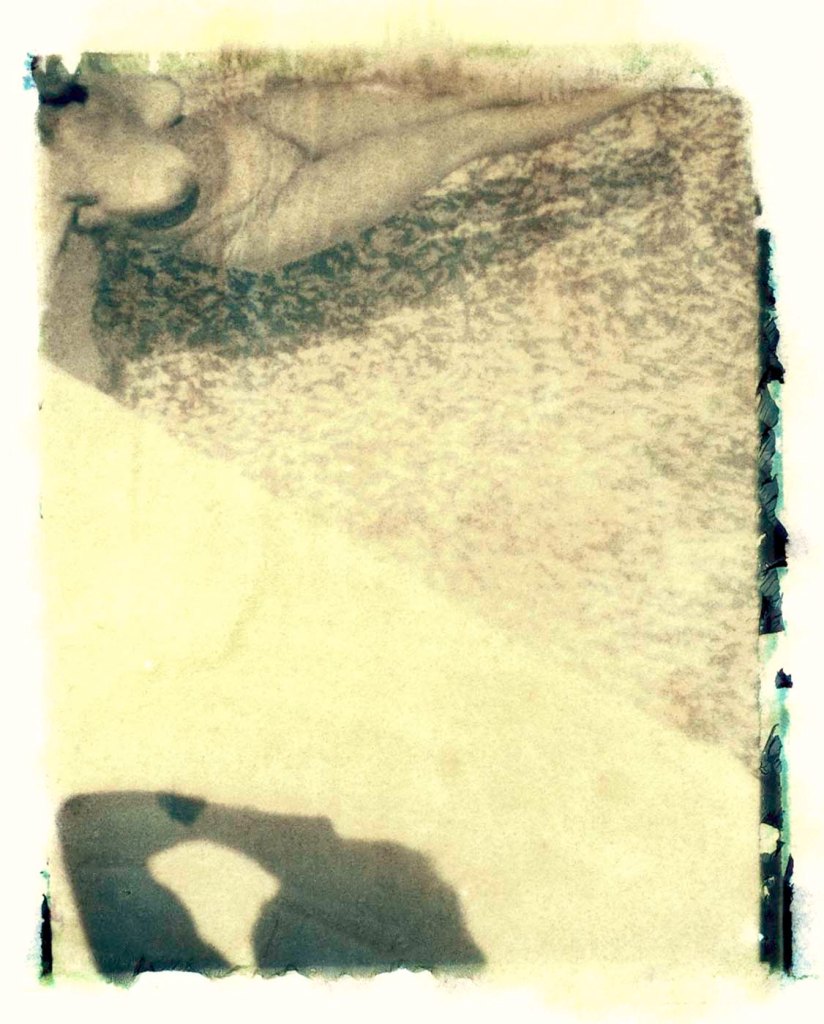
I recently was looking through one of my archival boxes of photographs and came across six Polaroid emulsion transfers that I created around 1998 or 1999. The process was complicated and getting a successful transfer was difficult. It involved using peel-apart film, soaking it in water until the image separates and floats, and then carefully moving it and placing it on a piece of paper without damaging the emulsion. I used Arches paper. I tried the process but did not enjoy it and the results were not always the best. Here is one of my transfers which I scanned from the original.

Off-Kilter Thoughts

What connections, if any, exists between my photography work and personal life?

What will be thought of my 50+ years of photographs?

Will my work be enriched by biographical knowledge or is it aesthetically sufficient to the viewer without personal background information?

Is my work “strong” enough without words of explanation?

What would a review of my work reveal?

Would it be better not to know anything about the artist?

Could the work be stronger without personal information or is that essential to the viewer?

Is it more satisfying to be emotionally connected to a work without knowing the artists emotions and intentions?

A work should stimulate a response in the viewer.

The work is more important than the artist.

The viewer is more important that the artist.

Work has more power than either the artist or the viewer.

What does my work say? What does my work not say?

Work does not have to say anything but may stir an unconscious spark in some viewers.

The artist may not know or care what the work says and prefer it that way.

The artist may not care what others think and others may not care what the artist thinks.

Culture Stagnation

“We are now almost a quarter of the way through what looks likely to go down in history as the least innovative, least transformative, least pioneering century for culture since the invention of the printing press.”

Jason Farago,
“Out of Time”, New York Times Magazine, October 15, 2023

I strongly feel that photography has also been in this deep cultural rut with little innovation and progress, and images that are not that good. This writing is a continuation of a previous post “The Photographic Dilemma” in which I am very critical of the state of photography and what I see as its downward progression into mediocrity over the past twenty years. According to Mr. Farago “…the present state of culture feels directionless…” which is how I feel about photography today.

I recently viewed two local art exhibitions. One was a members show (non-juried) which usually contains work of varied quality. The photographic pieces in the show just sort of blended into the wall. The other show was the Pennsylvania Annual Art of the State juried exhibition where the quality is much better but the work (especially photography) struggled for attention. The best photograph was a black and white image looking down on a street from several stories up which was composed of people walking amid geometric patterns. It showed a distinctive and unique eye of the photographer. I know this photographer and I know he has a track record of consistently creating exceptional work over a long period of time. We need more photographers of his caliber in today’s world.

It is as if many of today’s photographers have no interest in the history of photography and the images created by the photographers throughout that history. Perhaps, they have decided to throw out the past and assumed they were going to create something new. Unfortunately, this has not worked.

Ten years ago, Aperture magazine made a major change to their publication with the Spring 2013 issue where the main section of the magazine was divided into two parts–Words and Pictures. Beginning with that issue the number of pages compared to the previous issue (Winter 2012) nearly doubled (152 pages to 88 pages). This was not good for photography. The lackluster photographs have been diluted by words. As I wrote before in a post, it used to be said that a photograph was worth a thousand words. Now it is necessary to have a thousand words to explain a photograph. Aperture has done their part in contributing to culture stagnation as it relates to photography.

Today, an individual can scroll through thousands of photographic images but there is nothing to see. Culture is at a standstill.

The Photographic Dilemma

I keep asking myself “What is wrong with fine art photography today?” I am seeing lackluster photographs with little originality that lack a “voice” and originality. They are mostly mundane and show little creativity on the part of the photographer. The only photos that spark my visual excitement were made many years ago. What is causing this image drought? Is it the inundation of the large quantity of mostly bland pictures that we face today? Is it poor photography education or simply a lack of dedication and direction? How much can be blamed on the curators and gallerists who control what is seen? Is there a fog of visual laziness hovering over the field of fine art photography? How long will it last?

It is likely, that in this age of digital interruption, photographers cannot concentrate for the long periods of time needed in the process of artistic pursuit which prevents deep brain thinking from occurring. I also believe social media has dampened visual acuity with the impersonal likes and thumbs up giving a false sense of importance. The New York Times has been highlighting portfolios of photos from photographers that an editor has been following on-line. At best they come across as beginning photographers with some potential and at worst they are individuals with a camera or camera phone who take snapshots.

I have to think much of the blame for the uninspired photo production lies with photographers. It does not appear that they are “putting in the work” and devoting enough time to photography. Inability to focus attention and a lack of concentration may be major contributors.

I am hoping this is only a temporary cycle and that there will be a photographic resurgence in the near future—a renaissance period. It will be up to a future generation of photographers, teachers, curators, critics and patrons to change what I see as a continued downward spiral into mediocrity for photography.

Classic Post-Emotional States of a Fine Art Photographer

Photography covers the full spectrum of personal emotions.  I want to address the various emotional states that the act of photographing can elicit in the photographer.  There are photo historians, photo critics and photo curators who write reviews, articles, essays and books about photography and they experience their own emotional states as a viewer of photographs and they address their feelings regarding what they see and feel.  Photographers, as the creator of images, experience their own set of emotions, which can be varied and intense over the course of creating a finished photograph. I have seen little writing by photographers regarding their emotions from start to finish in the act of creating a photograph. Edward Weston in his Daybooks is one of the best examples of a photographer expressing his emotions. My experience as a fine art photographer is that there are three phases in the photography process and different emotions are associated with each phase.  The phases are: (1) the planning phase, (2) the shooting phase, and (3) the processing phase. There can be a fourth phase, the “show and tell phase”, when and if the photographer decides to exhibit photographs for public viewing, but for now I will focus on the first three that involve image creation.

The phases and emotions discussed are directly related to “fine art photography” where the intent is to create an image that transcends the commonplace and can reach some level of the artistic.  I consider myself a “fine art photographer” or at least I strive to be one, but on occasion I am a “snapshooter” recording a family event or travel experience.  As a “snapshooter” I am more casual and do not experience the same emotions or the intensity of emotions when I am the “fine art photographer.”  For me they are very distinct and different experiences and seldom, if ever, overlap. For me, snapshots do not become fine art photographs.

The “planning phase” is when decisions are made on equipment, subject matter, location, and in my case a model when I work with the nude.  For some photographers there may be a spontaneous shooting experience where there is little or no pre-planning, but for me I find that it is a rare phenomenon.  I just have to get mentally ready and usually have to work out the details.  For me, spontaneity plays a strong role during the shooting phase.  

Emotions in the “planning phase” are related to the decisions you make and results that you hope to achieve.  Anticipation and excitement are emotions that can be countered with anxiety and self-doubt.  You look forward to the photo experience, but you wonder whether it will be successful and worth the effort.  Have you made the right decisions on equipment and location or will you regret your choices?  Will the model show up or cancel at the last minute?  Leading up to the “shooting phase,” the anxiety can build and I can get a little nervous.  I am already wondering whether I will be able to create at least one “strong” image or will the shoot be one big failure?  The intensity of these feelings can also be dependent on the resources (time and money) that have already been invested.

Some of the emotions from the “planning phase” can spill over into the “shooting phase,” but once the camera is in hand a new set of dynamics take over.  A level of intensity takes control and my focus centers on the environment, subject/model, lighting conditions, etc.  For varied time periods, from a few seconds to a few minutes, I may enter what is sometimes referred to as “the zone,” but I feel this term is too vague and does not adequately describe the photographer’s experience.  I originally thought that “period of intensified concentration” was more descriptive of these special moments, which can also apply to a writer, artist and other forms of creativity and even sports where someone may say that the player is in the “zone.”  After additional contemplation, I believe that specific to photography a more appropriate term is “period of intensified perception.”  Concentration certainly plays a major role, but the visual act of seeing is critical.  Sometimes this “period of intensified perception” is never attained or I may have to be visually engaged for an hour or two before I experience it.  When this does occur it may be the stage when areas of the brain are activated which can push creative thought into the realm referred to in psychological terms as the “subconscious” or “unconscious.” There is more information regarding this in my other writings, “The Role of the Unconscious in the Creative Act” and “The Role of the Unconscious in the Creative Act—New Discoveries and Updated Thoughts.”   Plus, using the term “period of intensified perception” is a more descriptive term that is more understandable for individuals not interested in the psychology of the mind.

Other emotions that I relate to the “shooting phase” include:  astonishment when everything comes together as you hoped it would; frustration and even disappointment when one or more various elements seem to prevent you from getting the image you think you want; surprise when something unexpected happens and you get a shot that you did not know existed. As you pack up your gear and call it quits, you may experience a sense of elation when you think everything went really well.  A good day shooting is no guarantee of a good set of images and a bad day can give you that one great image.  Sometimes you don’t know until you get to the “processing phase.”  When shooting digital and having the ability to review shots, I find it difficult to determine what is good and what is not while on location.  For the few photographers still using film, you definitely won’t know what you have until you are in the darkroom. I find it useful to put some time (days and even months) between a shoot and actually working with the images… sort of a cleansing of the visual palate.

The “processing phase” involves either developing film and printing it in the darkroom or developing a digital image with a software program and printing it with a digital printer.  I find that I spend about the same amount of time with either method when completing a finished print.  For me digital did not make photography easier.

My emotional experience with the “processing phase” starts with hope.  I hope exposures were accurate, the focus sharp, the lighting just right and that there will be at least one image that will jump out visually.  Sometimes elation can be tempered with disappointment.   An image that initially looked promising can become a reject upon closer inspection.  Of course, the opposite sometimes occurs when an image initially overlooked turns out to be one of my best shots to my dismay and amazement. I believe that all individuals interested in photography have an active sense of curiosity and take pride in achievement.  I also believe that all serious photographers will experience emotional ups and downs throughout their photographic lives.  Hopefully, there will be more days of satisfaction rather than disappointment, more days of happiness, enjoyment, and amazement, and fewer days of sorrow, despair and frustration.  Celebrate the good days and cope with the bad days, using them as a learning experience. Success and failure are part of the fabric of photography.

Note: I referred to this essay in the previous post (Photography and A.I)

Stranglehold of Relevance

“The idea of the work of art as an imaginative achievement to which the audience freely responds is now too often replaced by the assumption that a work of art should promote a particular idea or ideology, or perform some clearly defined civic or community service.”

“I want us to release art from the stranglehold of relevance—from the insistence that works of art, whether classic or contemporary, are validated (or invalidated) by the extent to which they line up (or fail to line up with) our current social and political concerns.”  

From the book Authority and Freedom by Jed Perl—pages 16 and 19.

I believe that today’s photography is being choked to death in this “stranglehold of relevance.” So many of the photographic images I see today are centered on “race, gender and sexual orientation.” Museums, galleries and the media are so focused on these current trends that they are tripping over each other to obtain appropriate work. As a result, many of the photographers today choose their subject matter to appeal to these controllers of the image gateways in the hope they will be recognized. Pity the poor stand-a-lone photograph, even if it is far superior than the trendy image, and the photographer who created it. Too bad if you and your photographs don’t fit into the theme du jour.

Perhaps it is time that the image gatekeepers swing the pendulum back to a more balanced state of photography where all photography does not have to be relevant and the best images have a chance to be recognized.

I wonder how many of the master photographers of the past, who have been highly recognized by the photography world, would have fared in the current photography environment.

For example, the photographer Jerry Uelsmann died on April 4, 2022. His images were independent dreamscapes that are difficult to classify. They verged on the surreal and were created by combining multiple negatives in the darkroom. In 1967, he had his first solo show at the Museum of Modern Art in New York City and that same year he was featured in Aperture Magazine (issue 13:3, 1967). Today, I doubt that the world would even hear of Jerry Uelsmann and, with its current subject emphasis, Aperture would not have featured him (much to the chagrin of Minor White who founded and was the editor of Aperture.) 

Let us free photography from the current constraints and give it room to breathe.

Classic Post 3–Creators and Observers

I create my photographs but I do not interpret them. That is not my job. I let the observer do that. 

It is the observers’ job to discover their own interpretation. It is my hope that the viewer will emotionally connect with the image.

Today, we are visually saturated and I am concerned that the public does not really look at an image and try to discover what it is about. Simply indicating a social media “like” is not enough. We need more observers who are sensitive to aesthetic qualities in photographs.

I am also concerned that many of today’s photographers do not make images that go beyond the superficial surface of the subject whether it is animate or inanimate. Visually, many of the current images that I see lack depth and do not require anything more than a cursory glance. I subscribe to Aperture magazine and have noticed that the old adage that “a picture is worth a thousand words” should be changed to “it takes a thousand words to describe a photograph.” I now see many photos that cannot stand alone or even in a photo series without needing a lengthy critique which may vaguely explain or try to explain the significance of the work. It seems to me that photographers and writers are trying very hard to impress with their images and writings. Perhaps photographers lack the “vision” to create exceptional images and the writers use a lot of mumbo-jumbo to make themselves sound knowledgeable. We need more creators who see beyond the visually mundane.

There should be a visual relationship between the creator and the observer. The best photographs should create a spell on the observer.

Kant wrote the following about creative talent and genius. The talent/genius “does not know himself how he has come by his ideas; and he has not the power to devise the like at pleasure, or in accordance with a plan, and to communicate it to others in precepts that will enable them to produce similar products.”

There are photographs that I am unsure of how I created them and certainly will never be able to replicate. The technique of photography can be taught but the talent arises from the inner being.

The observer may experience similar emotions when viewing a photograph. The French have a phrase je ne sais quoi that refers to something that cannot be adequately described or expressed. Sometimes an image will leave the observer speechless and stir emotions and aesthetic senses.

The source of this emotional stirring and the connection to an image may be elusive and unexplainable. There are times when as an observer I relate to an image in such a way that verbal expression is neither possible nor necessary. I like numinous images-those that contain an element of mystery and appeal to the aesthetic sense.

It seems that the world is becoming more divided into creators and observers-those who make images and those who passively look. Unfortunately, there seems to be a dilution in talented creators and a diminished visual awareness of viewers. Some of this can be blamed on the barrage of images that the public is exposed to through modern technology but also blame can be directed to a lack of emphasis on visual literacy.