The mind plays games. As I have aged, I look back on my earlier work (years and decades ago) and question whether it was me who made the photographs and wrote the essays. They seem to have been made by a more talented photographer and writer. These thoughts got stirred up while I was looking through a book that I made in 1998 called “Subconscious Perceptions”.
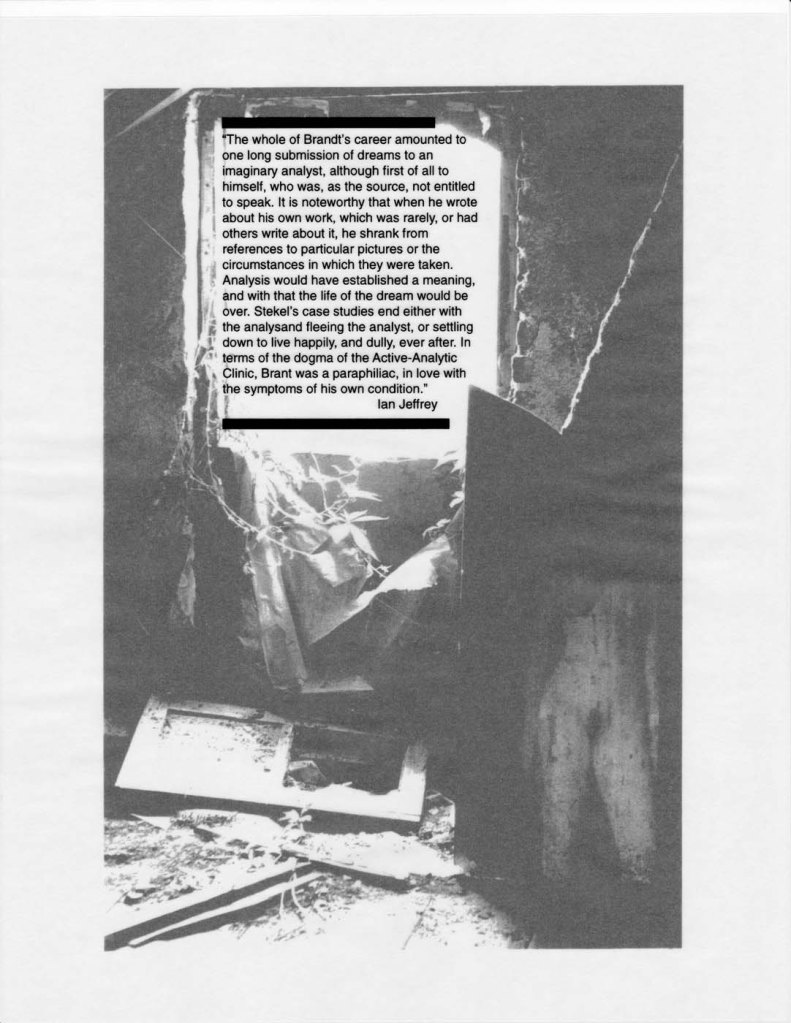
The book consisted of an opening statement and an essay adapted from my MFA thesis titled “The Role of the Unconscious in the Creative Act”. The photographs have an overlaying sheet of vellum that contains a quote related to the unconscious. I hired a graphic designer to create the vellum overlays, the title page and to typeset the printed pages. When I view the book today, I am amazed by the effectiveness of the combination of words and images. Unfortunately, I could not find anyone interested in publishing the book.
I write better than I talk. I am a visual person. When I write, I prefer to use paper and pen. I can see my written work. When I talk, my words are unseen and invisible to my visual brain.
When looking back at my work, has time caused me to see things different? Is my aged vision causing a warping in the way I see? Is my mind reformatting information through different neural pathways? Where did the ideas, the big words, the creative photographs come from? Did I do that? Maybe it is just a trick of my mind.
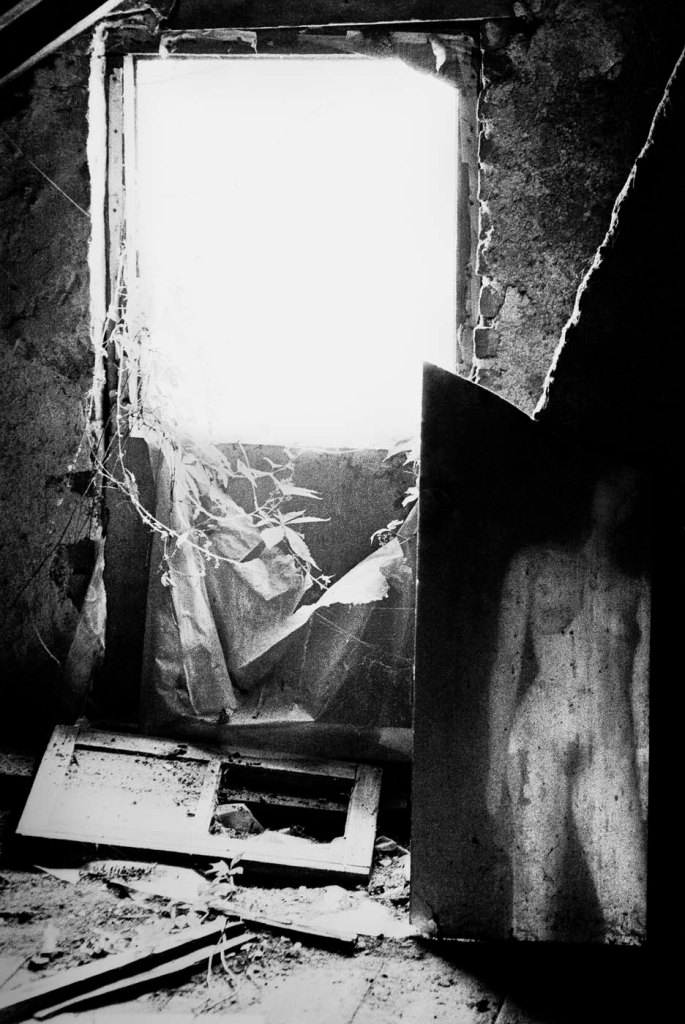
Examples: The first image is the photo with the vellum sheet covering the page. The second image is with the vellum removed. The quote is from the book Bill Brandt Photographs 1928-1983 which was edited by Ian Jeffrey.
Analog photography is still alive and does not want to go away. The latest analog news is the resurgence of old-time photo booths that still use developing chemicals and provide a black-and-white photo strip of four different poses. A company in New York called Classic Photo Booth salvages old booths and restores them. There is also a different company in Europe that refurbishes them.
Apparently, they are a big hit and people are lining up to use them. It is another sign that people are looking for other options besides digital. I am certainly trying to do my best to keep analog alive. I still use 35mm, medium format and 8×10 large format film in my photographic work.
There are now digital “photo booths” that mimic the old-time booths. I attended a wedding where a digital “photo booth” was in operation. Actually, there is no booth involved but just a table, a backdrop, a camera, a printer, some props and an operator. A photo strip of three poses was provided. The digital booth lacked some of the spontaneity of the old-time booth where there was no operator and you enter the booth and close a curtain for some privacy. The photos took minutes to develop, wash, and dry before a strip of images dropped into a slot for pick up.
Photo booths were also used by artists in their creations. Probably the most famous was Andy Warhol and his work with portraits and self-portraits in the 1960’s which he used to produce silk screen prints.
In 2025, the photo booth is 100 years old. Let’s hope analog photography can survive another century.
Photo shot with black and white film using a vintage Olympus Stylus Epic camera. All images are copyrighted.
“he, too, was one of those who pursue life as it flees, a hunter of the unattainable, like the takers of snapshots.”
From the short story “Adventures of a Photographer” by Italo Calvino
I am not sure why photography was so associated with hunting where words such as, photo shoot, snapshot, and capture, are part of the language of photography. Historically (1800’s), the snapshot was a term used in hunting to describe a quick shot. It may have also been the sound that hunting rifles made when fired. Personally, I do not like the word “hunter” which makes me think of killing. I think most photographers are harmless. Why not just use the word photographer. In a previous post “Psychology and Photography” I stated: “I am not a hunter and I do not hunt with my camera but am constantly searching for new avenues for my photography.” The search for the unattainable is a valid characteristic of many photographers. Despite the many failures, the drive to keep looking and photographing seems to be instinctual.
I am a photographer in search of the unattainable. I am always searching for the next great photo. It is my hope that I will get one “exceptional” image during a photo session. Basic elements such as composition, lighting, exposure and focus must be satisfied but more important is whether the image visually excites me. Does it have unique visual qualities such as an interesting juxtaposition, a certain pose or look, a special element that is an unanticipated surprise. The image must make me want to look. Unfortunately, such photos are rare but that doesn’t stop me from my photo searching. The photograph must visually rise above my other images.
It is an innate obsessiveness to find something or someone worthy of photographing. Even when I do not have a camera with me, I still see life in photographic terms. For me, there are unlimited possibilities.
Analog photography is very tactual. I recently was loading large format sheet film into 8 by 10inch film holders which I use in my pinhole camera. It is a very tactile process since it has to be done in total darkness and involves the sense of touch. The film has notches in one of the corners which identify the type of film and also indicates which side is the emulsion side (which has to face out). The dark slide which covers the unexposed film until ready to be used has little bumps along the silver side the top edge which indicates that the film under that side of the slide is unexposed and ready to be used. The other side is black with no notches and this indicates that this film has been exposed. Sounds complicated but the point is that touch is integral to the process.
After I was done loading the film holders, I realized how much I enjoy the tactile sensations experienced in analog photography. The tactile sensations continue through taking the photographs and processing the negatives. Touch is involved in every step.
Whether you are using large format film, medium format or 35mm, touch is essential. Loading exposed film in the dark into a film developing tank in preparation for processing requires touch and dexterity. I use stainless steel developing tanks and reels and I find that the cool smooth touch of the metal is pleasurable.
It is obvious that analog photography has many more opportunities for tactile stimulation than digital photography. I also use digital capture and processing. Sight rather than touch is the most valuable sense in digital photography. Loading and unloading a memory card along with using a computer screen, a mouse and keyboard is basically the tactual highlights. Touching photo paper is the most tactual thing I do in digital.
Over the decades, I feel that my analog work is far better than my best digital work. I recently attended the NiNPAH (Nude in Nature Photo Art Haven) event where I worked with two models for two hours each. I decided to only use black and white film. I exposed two rolls of 36 exposures with each model which is my usual shooting pace. When working in black and white, I visually interpret the scene into a gray scale. I even prefer to watch old television shows and movies that were filmed in glorious black and white. For me, color photography requires a different mindset and is visually less fulfilling than black and white photography.
For me, the tactility of analog photography has no comparison with digital photography. Perhaps that is why there has recently been more interest in analog. People want more of a hands-on approach. I admit that there are many ways to mess up throughout the analog process. I have made what is probably every mistake possible but that is part of the challenge and the results are rewarding.
I can see why most people prefer digital. It is more full-proof (although I have managed to find ways to screw up).
My final argument for analog is that film cameras are less complicated than digital. My Nikon F100 film camera manual has 111 pages. My Fujifilm 645i medium format film camera is 39 pages. My Nikon D750 digital camera manual is 504 pages. In my analog influenced opinion, digital did not make photography easier.
Digital photography is here to stay for now. I only hope that a small space will continue to exist for the few who still use analog photography and value its tactility.
A recent black and white photograph. All images copyrighted.
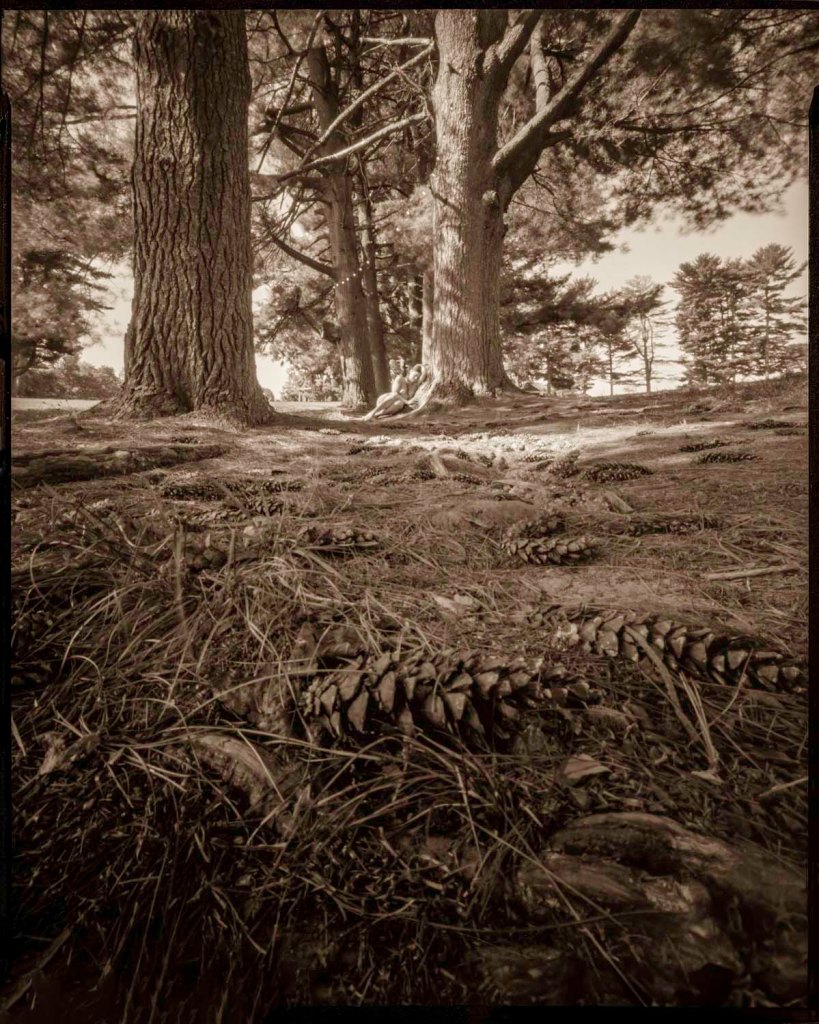
It has been two years since I last used my pinhole camera. I made the camera over twenty years ago. It is made out of plywood, a little bit of foam rubber insulation, and a lot of black duct tape to help make it light tight. I use old film holders that I load with 8-inch by 10-inch black and white sheet film. I used brass shim stock and a #9 sewing needle to make the actual pinhole. A friend gave me an old Packard-Ideal shutter that uses a pneumatic bulb attached to a tube to open and close the shutter. I installed small levels on two sides to help keep the camera level. I use a hand- held light meter to get an initial reading but also use a reciprocity chart to help compute a more accurate exposure time. Exposure times are usually in the 7-20 second range which means the subject must try not to move while the film is being exposed. Film has become very costly. A box of 25 sheets is now over $200 US which means that each exposure is $8 per sheet of film.
There are many challenges when using this camera and numerous ways to ruin a sheet of film. Exposures have to be accurate and subjects have to stay very still. There is the threat that a light leak may ruin an image. I have also gotten careless and forgot to return the slide back into the film holder and the film is totally ruined. I have had the shutter not fully open or close which results in another failure. Also, using the pinhole camera requires extra time to set up and post-processing the film can take hours. There is no guarantee that a good image will result from my efforts. I have no idea what I have until the film is developed.
With the potential for failure, the high costs, and the challenges to making a good photograph, the question is: Why do I use a pinhole camera?
First, I like the way the images look. There is a dream-like softness and ethereal quality to the images. Part of this may be due to the fact there is never a super sharp focus like you get using a camera with a lens. Another quality is there is an infinite depth-of-field from the closest to the farthest object. The angle of view for my camera is very wide. I like the resulting distortion which can make items close to the camera appear stretched. Sometimes accidental movement by the model can add to an image and even an accidental light leak can occasionally benefit an image. I like working with large format film and I like the uncertainty of the results. I set everything up and hope for the best.
Despite all the negative aspects of using the pinhole camera, when everything goes right the resulting photograph is special and one of a kind. It can even be magical.
I seem to have an innate desire to get to the root of creativity even though I know it is an impossible task. I have previously written essays on the subject of creativity, especially as it relates to photography. The most recent book I read is Stolen Focus-Why You Can’t Pay Attention and How to Think Deeply Again by Johann Hari. Focus is not used as the photography term but the thinking term for clear perception and understanding.
Hari uses the phrase “mind wandering” which can result when the external stimuli are turned off and you can actually let your brain drift and think without interruption. The difficult part is that you have to stop the “noise.” You have to give your mind room and space to process thoughts. This means you have to slow down the input to your senses. A major benefit of turning off the hyper-world is regaining the ability to allow for mind wandering which can open the door for creativity.
“Creativity is not (where you create) some new thing that’s emerged from your brain. It’s a new association between two things that were already there.” –Stolen Focus, page 96.
I question how one can be creative when trying to process all the external stimuli that bombards the senses non-stop. Unfortunately, many people are so conditioned by this constant “noise” that they find it difficult to turn off the hyper-world. How many people can turn off their electronic devices for a day without feeling anxious?
Whether you are a photographer or not, give your mind room to wander, slow down the unnecessary external stimulation and take the time to observe and interact with your environment.
Uprooted Series (in camera double exposure on film)


 Sleeping Mind Photography